
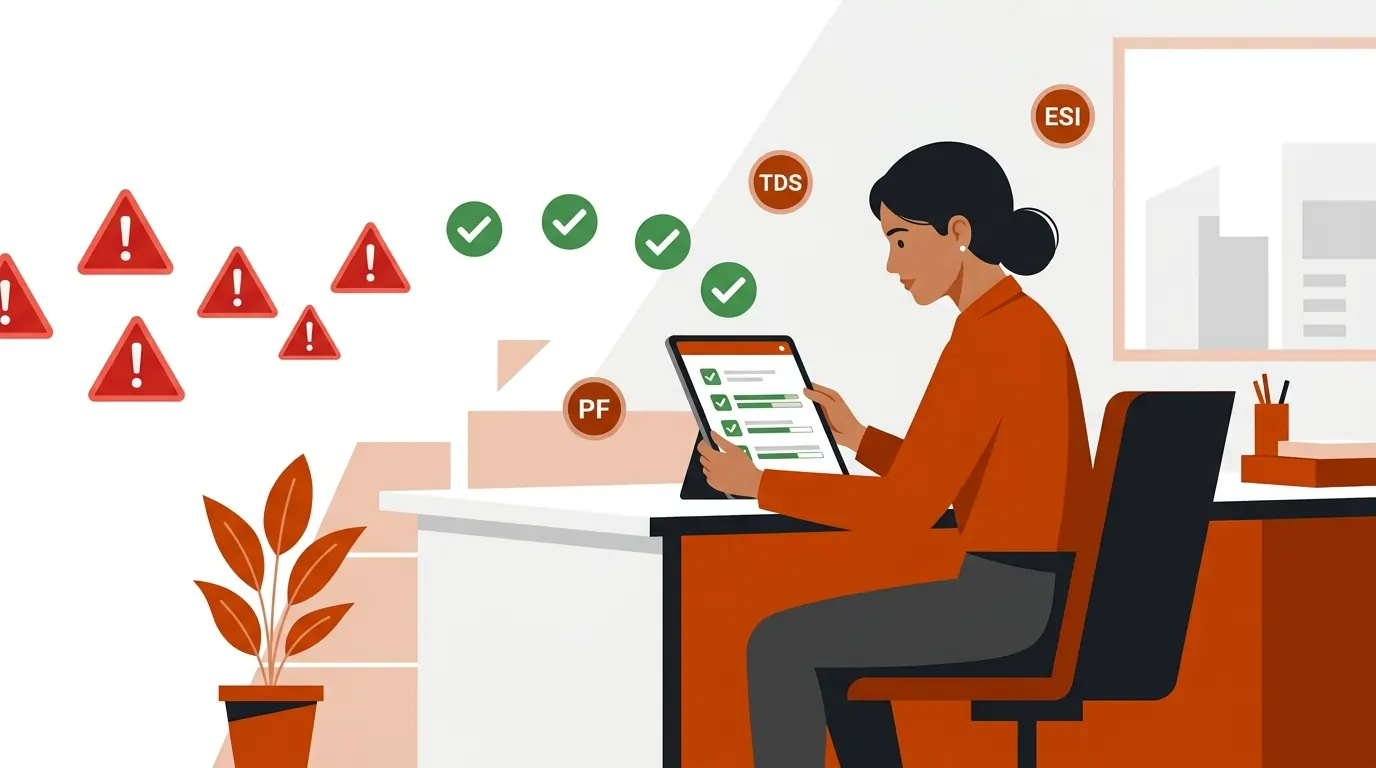
India’s payroll compliance framework is one of the most complex in the world. Provident Fund, ESI, TDS, Professional Tax, Labour Welfare Fund, gratuity, bonus — each governed by different laws, with different calculation rules, filing deadlines, and penalty structures.
For most companies, payroll compliance is handled by a combination of manual spreadsheets, accounting software, and institutional memory sitting in one payroll officer’s head. That’s a fragile system — and when it breaks, the consequences range from costly penalties to reputational damage to legal scrutiny.
Here are the 10 most common payroll compliance mistakes Indian companies make, what they actually cost, and how modern payroll software prevents every single one.
Mistake 1: Incorrect PF Contribution Calculations
Employees’ Provident Fund (EPF) contributions must be calculated on ‘basic salary + dearness allowance’. A common mistake is calculating PF on gross salary — which overstates contributions — or excluding allowances that legally count as basic pay.
The Employees’ Provident Fund Organisation (EPFO) conducts regular audits, and discrepancies trigger demands, interest at 12% p.a., and penalties up to ₹5,000 per violation.
| Fix: PulseHRM automatically maps salary components to the correct PF-eligible base. The system flags mismatches during payroll processing, before they become compliance issues. |
Mistake 2: Missing TDS Filing Deadlines
Tax Deducted at Source (TDS) on salaries must be deposited with the government by the 7th of each following month. For March, the deadline is April 30th. Missing these deadlines attracts interest at 1.5% per month under Section 201(1A) of the Income Tax Act.
More critically, quarterly TDS returns (Form 24Q) must be filed by specific dates. Late filing carries fees of ₹200 per day under Section 234E, capped at the total TDS amount.
| Fix: PulseHRM generates automated TDS computation, Form 16 generation, and filing-ready 24Q reports — with deadline alerts to ensure nothing slips through. |
Mistake 3: Misclassifying Contract vs. Full-Time Employees
Companies frequently misclassify regular employees as ‘contract workers’ or ‘consultants’ to avoid PF and ESI contributions. Under the Contract Labour (Regulation and Abolition) Act 1970 and recent Labour Codes, this is heavily scrutinised.
If a contractor is found to be functionally an employee — working set hours, under direct supervision, on company premises — the company is liable for backdated statutory contributions, penalties, and potential criminal liability for the employer.
| Fix: PulseHRM’s employee database includes employment type classification with role-based compliance triggers — ensuring the right statutory rules apply to the right employees from day one. |
Mistake 4: Not Updating Salary Structures After Increments
When an employee gets a salary increment, the entire statutory calculation stack needs to be recalibrated: PF contributions, ESI eligibility (employees earning over ₹21,000/month are exempt from ESI), income tax slab, and PT.
Companies frequently update basic pay in the payroll sheet but forget to recalculate downstream. The result is month after month of incorrect deductions that compound into large arrears.
| Fix: In PulseHRM, a salary revision triggers an automatic recalculation of all downstream components — no manual reconfiguration needed across linked statutory modules. |
Mistake 5: Ignoring Professional Tax Rules by State
Professional Tax (PT) is levied by individual state governments, and the rules differ significantly. Maharashtra, Karnataka, Andhra Pradesh, Tamil Nadu, West Bengal — each has different slab rates, maximum caps, and filing frequencies.
Companies operating across multiple states (even just two) need state-specific PT logic. A single national payroll template gets this wrong by definition.
| Fix: PulseHRM supports state-specific PT configurations, handling multi-state payroll without needing separate systems or manual overrides. |
Mistake 6: Incorrect ESI Applicability
ESI (Employees’ State Insurance) applies to employees earning up to ₹21,000 per month (₹25,000 for persons with disabilities) in establishments with 10+ employees. The contribution rate is 3.25% (employer) + 0.75% (employee) of gross wages.
Companies frequently fail to enrol newly eligible employees, continue deducting ESI from employees who have crossed the threshold, or exclude allowances that count as wages under the ESI Act.
| Fix: PulseHRM automatically monitors each employee’s ESI eligibility status month by month — enrolling, excluding, or flagging for review as salary or headcount changes occur. |
Mistake 7: Not Maintaining Statutory Registers
Under the Factories Act, Shops and Establishments Acts, and Labour Codes, employers are required to maintain specific registers — Wage Register, Attendance Register, Register of Advances, etc. — and make them available for inspection.
In practice, these registers are either not maintained, maintained incorrectly, or maintained in formats that don’t match the prescribed structure. Labour inspector visits can result in fines and orders for immediate compliance.
| Fix: PulseHRM auto-generates statutory registers in prescribed formats from existing payroll and attendance data — so you’re always audit-ready, without any extra work. |
Mistake 8: Incorrect Gratuity Calculations at Exit
Gratuity under the Payment of Gratuity Act 1972 is payable to employees who have completed 5+ years of continuous service. The formula: (15 x last drawn salary x years of service) / 26.
‘Salary’ here means basic + DA only — excluding HRA, allowances, and bonuses. Miscalculations, especially at the time of exit when emotions run high, lead to disputes, labour court complaints, and reputational damage.
| Fix: PulseHRM’s Full and Final Settlement module calculates gratuity, leave encashment, and notice period adjustments automatically at offboarding — using the legally correct formula and salary components. |
Mistake 9: Ignoring New Labour Code Obligations
India’s four new Labour Codes — covering wages, industrial relations, social security, and occupational safety — are being progressively implemented by states. The Code on Wages, for example, mandates that ‘wages’ for calculating overtime, PF, and gratuity must be at least 50% of CTC.
Many companies that engineered low-basic / high-allowance salary structures to reduce statutory contributions may find those structures non-compliant under the new codes once fully enacted.
| Fix: PulseHRM stays updated with regulatory changes and alerts administrators when salary structures may fall outside compliance boundaries under applicable laws. |
Mistake 10: Relying on One Person to ‘Know’ Payroll
The single biggest compliance risk for small and mid-sized companies is institutional knowledge concentration. When payroll depends on one experienced person — and they resign, fall ill, or take a holiday during payroll week — everything stops.
Worse, undocumented manual adjustments, workarounds, and exception handling built up over years often violate compliance standards that nobody even knew existed.
| Fix: PulseHRM moves payroll out of spreadsheets and individual heads into a structured, auditable, documented system. Every calculation is traceable. Every exception is logged. New team members can take over payroll without a six-month learning curve. |
The True Cost of Getting Payroll Wrong
India’s labour law penalties are not trivial:
- EPF default: penalty up to 25% of arrears + prosecution under EPF Act
- TDS late deposit: 1.5% per month interest + 18% per annum if wilful
- ESI non-compliance: imprisonment up to 1 year and/or fine up to ₹4,000
- Non-maintenance of statutory registers: fines under respective state Acts
Beyond penalties, payroll errors damage employee trust in ways that take years to rebuild. An employee who notices a wrong TDS deduction, a short gratuity payment, or a missed PF contribution becomes disengaged — even if the error is corrected.
Automate Compliance. Eliminate Risk.
The most reliable way to avoid payroll compliance mistakes is to stop doing payroll manually. Modern payroll software — designed specifically for India’s regulatory environment — handles the complexity automatically.
PulseHRM’s payroll module covers PF, ESI, TDS, PT, LWF, gratuity, bonus, and Full and Final Settlement — all within a single integrated platform. It’s built by a team that understands India’s compliance landscape, and it’s updated as regulations change.
Stop paying penalties for preventable mistakes. Book a free demo with PulseHRM today and see how automated payroll compliance works in practice.
