
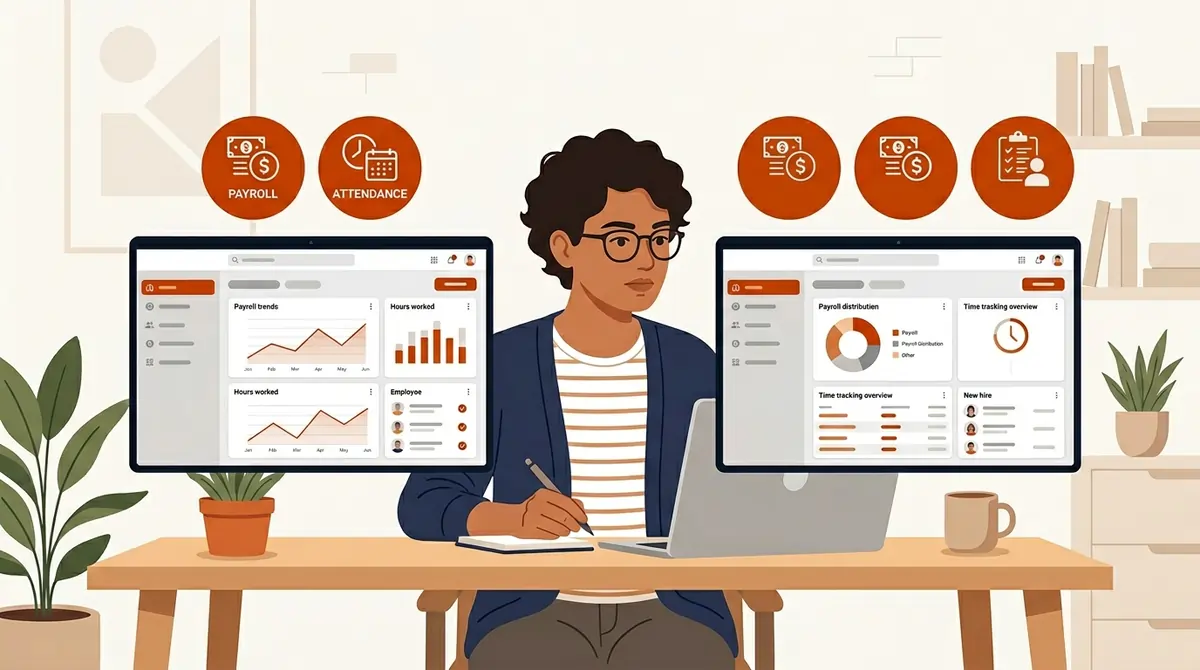
Here’s the thing nobody tells you when you’re hiring your 20th employee: a spreadsheet that worked brilliantly at 10 people becomes a liability at 30. Attendance is wrong, payroll takes a week, and your HR manager spends more time answering “how many leaves do I have?” than actually managing people.
The answer is an HRMS — a Human Resource Management System. But with dozens of options in the Indian market, choosing the right one for a small business is genuinely hard. This guide breaks down exactly what to look for, compares the leading options, and explains which platform is best suited for which type of business.
What Should an HRMS Do for a Small Business?
Before comparing products, it’s worth being clear on what you actually need. Small businesses in India typically have 5–7 core requirements:
- Payroll processing with full statutory compliance (PF, ESI, TDS, PT)
- Attendance tracking — ideally with biometric and/or GPS support
- Leave management with approval workflows
- Employee records and document storage
- Performance management and appraisal workflows
- Recruitment and onboarding support
- A mobile app so employees can self-serve from anywhere
The biggest mistake small businesses make is buying an enterprise-grade system with 50 modules they’ll never use, or buying a payroll-only tool that forces them to add three other platforms later. The sweet spot is a comprehensive but practical platform designed for Indian compliance from the ground up.
Key Criteria for Evaluating HRMS Software in India
1. India-Specific Statutory Compliance
This is non-negotiable. Your HRMS must handle PF, ESI, TDS, Professional Tax (state-specific), Labour Welfare Fund, Gratuity, and Bonus Act calculations automatically. A generic international HR tool may have payroll — but it won’t know that Maharashtra PT slabs are different from Karnataka’s.
2. Ease of Use for Non-Technical Teams
Most small businesses don’t have a dedicated IT team. The system must be intuitive enough for an HR manager with no technical background to set up and operate. Look for guided onboarding, clear navigation, and responsive support.
3. Biometric and Mobile Integration
With field teams, remote workers, and multi-location operations increasingly common, your HRMS needs to connect with biometric devices and offer a mobile app for GPS-based attendance. This is a differentiator — not every platform offers it.
4. Pricing That Scales With You
Small businesses need flexible pricing — typically per-employee per-month. Watch out for hidden costs: implementation fees, data migration charges, extra charges for mobile access, or minimum seat counts that make the software expensive for small teams.
5. Implementation Speed
Enterprise implementations take months. A small business HRMS should be live in days or weeks, with data migration support and a clear onboarding process.
Top HRMS Platforms for Small Businesses in India
| Platform | Best For | India Compliance | Biometric Integration | Mobile App | Pricing Model |
| PulseHRM | Growing SMBs, multi-location teams | Full (PF, ESI, TDS, PT, LWF) | Yes — ESSL, BioMax, Mantra, Star Link | Android + iOS | Per employee/month |
| Zoho People | Tech-savvy teams wanting customisation | Partial (via integrations) | Limited | Yes | Per employee/month |
| greytHR | Payroll-heavy businesses | Strong payroll compliance | Yes (limited models) | Yes | Per employee/month |
| Keka HR | Mid-market companies (50+ employees) | Good | Yes | Yes | Higher minimum pricing |
| Razorpay Payroll | Payroll-only needs | Strong payroll | No | Limited | Per employee/month |
Each platform has its strengths. But for a small business in India that needs a complete, affordable, India-compliant HRMS with genuine biometric integration and a mobile app — PulseHRM is the most rounded choice.
Why PulseHRM Is Built for Indian Small Businesses
Complete Employee Lifecycle in One Platform
PulseHRM covers every stage from recruitment and onboarding through daily workforce management, payroll, performance, and offboarding. Small businesses don’t need to stitch together five tools — one platform handles everything.
Built for India’s Compliance Complexity
PulseHRM’s payroll engine handles PF, ESI, TDS, state-specific PT, LWF, Gratuity Act, and Bonus Act calculations natively. Statutory registers are auto-generated. Form 16 and 24Q are produced at click. Updates track regulatory changes so you don’t have to.
Biometric + GPS Attendance That Actually Works
PulseHRM integrates with ESSL, BioMax, Mantra, and Star Link biometric devices — the most widely used brands in India. For teams in the field, the GPS-enabled mobile app allows real-time check-in/out from any location. All attendance data flows directly into payroll — no manual entry, no reconciliation.
A Self-Service Experience Employees Actually Use
With PulseHRM’s employee self-service portal (available on mobile and web), employees can check leave balances, apply for leave, view payslips, download documents, and update personal information without raising a single ticket to HR. This alone can free up 8–10 hours of HR time per week in a 50-person company.
Managed Services for When You’re Not Ready to DIY
PulseHRM is unique in offering Managed Payroll Services alongside its software — so if you’re not ready to run payroll in-house yet, their team of experts handles it for you. As you grow and build HR capability, you can transition to self-service at your own pace.
How to Choose: A Simple Decision Framework
If you’re still deciding, here’s a straightforward way to think about it:
- Under 25 employees, payroll-only need: A basic payroll tool may suffice. But if you’re growing, invest in a full HRMS now — migration later is painful.
- 25–100 employees with biometric attendance: PulseHRM is the strongest fit. The biometric integration and India-native compliance are differentiators at this size.
- Remote-first or field-heavy teams: GPS attendance via mobile app is essential. PulseHRM’s mobile offering is purpose-built for this.
- Multi-location business: You need consolidated reporting across locations. PulseHRM handles multi-branch setups with centralised dashboards.
- Want to outsource payroll initially: PulseHRM’s Managed Payroll service lets you start with experts running payroll and transition to self-service when you’re ready.
Questions to Ask Any HRMS Vendor Before You Sign
- How is PF/ESI/TDS calculated — natively or via a third-party integration?
- Which biometric device brands do you support?
- What is your implementation timeline for a 50-person company?
- Are regulatory updates (new Labour Codes, budget changes) included, or do I pay extra?
- What does customer support look like — chat, phone, dedicated account manager?
- Is there a free trial or demo I can run with real data?
The Bottom Line
The best HRMS for a small business in India is one that handles the full employee lifecycle, is built for Indian statutory compliance, integrates with the attendance tools you already use, and is priced fairly for a growing team.
PulseHRM checks all of those boxes — and adds managed services for teams that aren’t yet ready to run HR fully in-house.
The best time to implement an HRMS is before your next hire. Book a free demo with PulseHRM and see it running on your actual use case.
