
Ask any HR manager in India what eats most of their week, and leave management will feature in the answer. Between policy disputes, approval delays, payroll deduction errors, and employees who take leave without notifying anyone — leave management is one of the most time-consuming and conflict-prone parts of running HR in India.
And yet, most companies still manage it through WhatsApp messages, email chains, and spreadsheets that are out of date the moment someone submits a new request.
This guide covers everything you need to build a leave management system that is legally compliant, fair, and operationally efficient — and explains exactly how HRMS software like PulseHRM automates the entire process.
Understanding Leave Types Under Indian Labour Law
India does not have a single national leave law — leave entitlements are governed by a combination of central Acts, state-specific Shops and Establishments Acts, and company-level HR policies. Understanding the baseline is the first step to building a compliant policy.
Casual Leave (CL)
Typically 7–12 days per year depending on the applicable state Act. Casual Leave is for unplanned, short-duration absences. It generally cannot be accumulated or encashed, and most Acts require minimum advance notice for planned casual leave.
Earned Leave / Privilege Leave (EL/PL)
Accrued based on days worked — typically 1 day for every 20 working days under the Factories Act (Section 79), translating to approximately 15 days per year for full-year employees. EL can usually be carried forward (up to a prescribed maximum) and encashed at retirement or exit.
Sick Leave (SL)
Most state Shops and Establishments Acts mandate 7–12 days of sick leave per year. Sick leave typically requires a medical certificate for absences beyond 3 consecutive days. Unlike EL, sick leave generally cannot be encashed.
Maternity Leave
Governed by the Maternity Benefit Act, 1961 (amended 2017). Women employees who have worked for at least 80 days in the 12 months preceding delivery are entitled to 26 weeks of paid maternity leave (for the first two children). For subsequent children, the entitlement is 12 weeks. This is a statutory right — companies cannot reduce it.
Paternity Leave
Not mandated by central law for private sector employees, but many companies offer 5–15 days as part of their HR policy. Central government employees are entitled to 15 days of paternity leave.
Public Holidays and Optional Holidays
Companies must observe national holidays (Republic Day, Independence Day, Gandhi Jayanti) and state-declared public holidays. Many companies additionally offer a set of optional/restricted holidays from which employees can choose based on their religion or regional festivals.
Key principle: The applicable leave rules depend on the state where the employee is located (under the relevant Shops and Establishments Act), the industry (Factories Act vs. service sector rules), and the company’s own HR policy — which cannot provide less than the statutory minimum but can be more generous.
Building a Leave Policy That Works
1. Define leave types and entitlements clearly
Your leave policy document should specify every leave type, the annual entitlement, accrual method (upfront vs. pro-rata), carry-forward rules, encashment eligibility, and the notice period required for each type. Vagueness in policy is the root cause of most leave disputes.
2. Set a clear approval hierarchy
Every leave application should have a defined approver — typically the direct reporting manager, with HR as a secondary approver for long absences or unusual patterns. The approval turnaround time should be stated (e.g., within 2 working days) to prevent employees from being left in limbo.
3. Establish blackout periods and minimum staffing rules
For teams or functions where minimum staffing is critical — customer support, production floors, accounts during month-end — define blackout periods and staffing floor rules. This allows managers to decline leave requests during peak periods without it feeling arbitrary.
4. Handle leave without pay (LWP) consistently
When employees have exhausted their leave balance, the policy must clearly state how LWP is treated: whether it requires separate approval, how it affects continuity of service for statutory benefits, and how it is reflected in payroll.
5. Address carry-forward and encashment upfront
Employees often don’t know their EL carry-forward limit until year-end — leading to rushed leave-taking in December. Communicate the carry-forward cap clearly, and consider sending automated alerts when balances approach the maximum so employees can plan.
The Leave Management Process: Step by Step
- Employee submits leave application — via self-service portal, mobile app, or leave management system — specifying type, dates, reason, and backup arrangement.
- System checks leave balance automatically and flags if insufficient balance.
- Notification sent to reporting manager for approval.
- Manager approves or declines within the prescribed timeframe. If declining, a reason is recorded.
- Employee receives confirmation. Approved leave is reflected in their dashboard and balance.
- Leave data syncs with attendance records automatically.
- At payroll cut-off, leave data flows into payroll — LWP deductions are calculated automatically, EL encashment is processed if triggered.
- At year-end, accrued balances are carried forward up to the maximum, and any excess is encashed or lapsed per policy.
This process sounds straightforward — but when it’s managed over email and spreadsheets, each step introduces delay, error, and conflict. Step 4 alone (manager approval via email) is where most processes break down, with requests unanswered for days and employees uncertain about their status.
Common Leave Management Problems in Indian Companies
| Problem | Root Cause | Impact |
| Employees unsure of their leave balance | No real-time visibility; balances only updated at month-end | Queries flood HR; employees take leave without checking |
| Approval delays of 3–5+ days | Managers approve via email; no structured workflow | Employee frustration; last-minute attendance issues |
| Payroll deductions disputed at month-end | Leave data not synced with payroll in real time | Trust erosion; re-calculation work for payroll team |
| Inconsistent policy application across teams | Managers exercise personal discretion; no system guardrails | Perceived unfairness; attrition risk |
| No visibility into team-level leave patterns | Data spread across emails and spreadsheets | Over-leave in some teams goes unnoticed until it’s a problem |
How PulseHRM Automates Leave Management End-to-End
PulseHRM’s leave management module is designed to eliminate every friction point in the process above:
- Configure any number of leave types with custom entitlements, accrual rules, carry-forward caps, and encashment policies — matching your exact HR policy document, not a generic template.
- Employees see real-time leave balances on web and mobile and apply for leave in under 60 seconds — no emails, no WhatsApp messages.
- Managers receive instant notifications and can approve or decline from their phone. The system enforces your defined turnaround SLA and escalates if no action is taken.
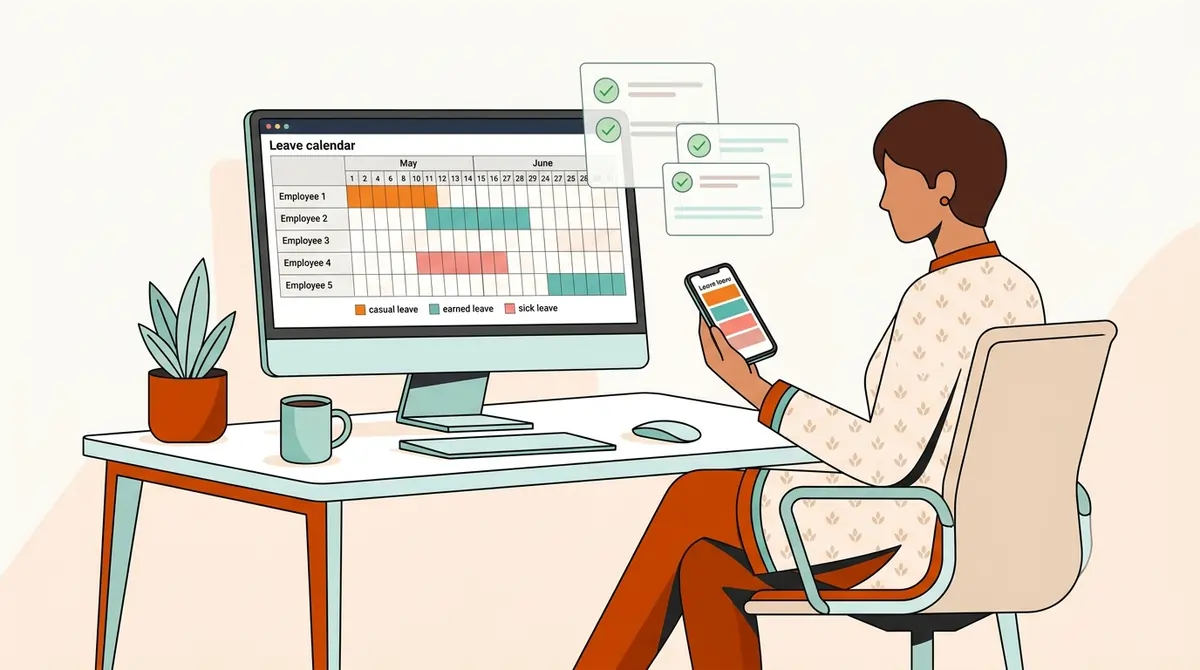
- Team leave calendars give managers instant visibility into who is on leave on any given day, making approvals context-aware.
- Leave data syncs automatically with attendance and payroll — LWP deductions are calculated without any manual reconciliation.
- Year-end carry-forward and encashment processing is automated based on your policy rules — no year-end spreadsheet exercise.
- HR gets a dashboard showing leave utilisation rates, absenteeism patterns, and employees approaching carry-forward limits — proactively, not reactively.
PulseHRM customers report a 75–80% reduction in leave-related HR queries after implementing the self-service leave module — because employees can see everything they need without contacting HR.
Leave Management for Remote and Hybrid Teams
Post-pandemic, many Indian companies now have a mix of office-based, remote, and hybrid employees. Leave management for distributed teams requires a few additional considerations:
- Work-from-home vs. leave distinction: Clearly define in policy whether WFH days can substitute for sick leave or whether they are separate. Configure this distinction in your HRMS so it is applied consistently.
- Time zone awareness: For companies with employees in multiple states, holiday calendars need to be location-specific. PulseHRM supports state-specific holiday lists so employees in Maharashtra and Karnataka don’t share an identical holiday calendar.
- Manager visibility across locations: Team calendars in PulseHRM are location-filtered, so a Hyderabad-based manager can see their team’s leave patterns without noise from other locations.
The Bottom Line
Managing employee leaves in India is genuinely complex — but the complexity is manageable if you have the right policy framework and the right tools in place. The companies that get this right don’t just reduce HR admin — they create a culture of fairness and transparency that employees notice.
PulseHRM’s leave management module is ready to configure to your exact HR policy in hours, not weeks. Book a free demo today and see how it eliminates the leave management headaches you’re dealing with right now.
